

How to Build a Charcuterie Board for Beginners
Last Updated: October 25, 2026
Quick Summary
How to build a charcuterie board for beginners starts with selecting at least three cheeses, two to three cured meats, crackers, and accompaniments like olives and fresh fruit. Arrange them using a fixed sequence: place bowls first, then cheeses, meats, crackers, olives, fruit, and garnish last. A beginner can assemble a six-person board in about 15 minutes.
- Choose at least three cheeses with different textures: one hard, one soft, and one semi-soft.
- Plan for 1 ounce of cheese and 0.5 ounces of meat per person if serving as an appetizer.
- Assemble your board no more than 2 hours before serving to keep cheese fresh and crackers crisp.
- Remove cheese from the refrigerator 30 minutes before serving to allow flavors to develop fully.
- Use a fixed build order: bowls, cheeses, meats, crackers, olives, fruit and nuts, then garnish.
Table of Contents
- Understanding the Basics of a Charcuterie Board
- Selecting Your Cheeses and Cured Meats
- How Much Charcuterie Per Person to Serve
- Building Your Charcuterie Board Shopping List
- How to Arrange a Charcuterie Board for Visual Impact
- Charcuterie Board Ideas for Beginners
- Preparing and Serving Your Board
- Frequently Asked Questions
Understanding the Basics of a Charcuterie Board
A charcuterie board is a serving platter that combines cured meats, cheeses, crackers, and accompaniments arranged for sharing. The name comes from the French word for pork butchery, but modern boards showcase far more than just meat.
The appeal of a charcuterie board lies in its flexibility. You control the ingredients, flavors, and presentation. There's no single "right way" to build one, which is why learning how to build a charcuterie board for beginners is so approachable. You're not following a recipe with exact measurements.
Start with these core elements:
- Cheeses (at least 3 varieties for variety)
- Cured meats (prosciutto, salami, or similar)
- Crackers and bread (for spreading and pairing)
- Accompaniments (olives, pickles, peppers, or other small bites)
- Fresh elements (fruit and nuts for sweetness and crunch)
- Finishing touches (herbs, edible flowers, or specialty salts)
The beauty of how to build a charcuterie board for beginners is that you don't need expensive equipment or culinary training. A wooden platter, some quality ingredients, and a thoughtful arrangement are all you need to impress your guests.
Selecting Your Cheeses and Cured Meats
Choose at least three cheeses with different textures and flavors. This variety keeps the board interesting and gives guests options. A good mix includes one hard cheese, one soft cheese, and one somewhere in between.
Hard cheeses offer sharp, concentrated flavors. Aged Cheddar, Gruyère, or Parmigiano-Reggiano work well. They're sturdy and won't crumble easily when guests slice them.
Soft cheeses feel creamy and rich. Brie, goat cheese, or fresh mozzarella add elegance to your board. They pair beautifully with crackers and fruit.
Semi-soft options like Gouda or Manchego bridge the gap between the two. They're approachable and pair with almost everything.
For cured meats, select 2-3 varieties. Prosciutto adds delicate, salty flavor. Salami brings spice and texture. Sopressata offers bold taste.
Quality matters here. Better ingredients taste noticeably better, and your guests will taste the difference. This is where drizzle pear white balsamic over fresh fruit and cheese can elevate even simple pairings.
How Much Charcuterie Per Person to Serve
Plan for 2-3 ounces of cheese and 1-2 ounces of cured meat per person if your board is the main event. If it's an appetizer before dinner, reduce that to 1 ounce of cheese and 0.5 ounces of meat per person.
For a beginner board serving six people as an appetizer, buy:
- 1 pound of cheese (split among 3 varieties)
- 6-8 ounces of cured meats (2-3 types)
- 1 box of crackers (about 40-50 crackers)
- 1-2 cups of accompaniments (olives, pickles, peppers)
- 2 cups of fresh fruit
- 1 cup of nuts
These quantities prevent waste while ensuring you have enough variety. A common mistake is buying too little. Guests eat more than you'd expect, especially at gatherings. It's better to have leftovers than to run out mid-party.
Adjust these amounts based on your guest count and the occasion. A casual afternoon snack needs less than an evening entertaining event. A board for 12 people requires roughly double these quantities.
Building Your Charcuterie Board Shopping List
A shopping list is only useful if it tells you how much to buy. The list below is built for a beginner board serving 6 people as an appetizer, with quantities that scale linearly. Multiply every amount by the number of guests divided by six.
Cheeses (about 1 pound total, split among 3 varieties):
- 5-6 ounces hard cheese (Parmigiano-Reggiano, aged Cheddar, or Gruyère)
- 5-6 ounces soft cheese (Brie, goat cheese, or fresh mozzarella)
- 5-6 ounces semi-soft cheese (Gouda, Manchego, or similar)
Cured meats (6-8 ounces total, 2-3 varieties):
- 3 ounces prosciutto, thinly sliced
- 3 ounces salami or sopressata
- 2 ounces of one additional variety (pancetta, spicy soppressata, or pepperoni)
Crackers and bread:
- 1 box plain crackers (about 8-10 ounces)
- 1 box seeded or herb crackers (about 8-10 ounces)
- 1 small baguette or 1 package breadsticks
Accompaniments (1-2 cups total):
- 1 jar olives (green and/or black), about 6-8 ounces drained
- 1 jar cornichons or pickles, about 5 ounces drained
- 1 jar roasted red peppers, about 7 ounces drained
- 1 jar marinated artichoke hearts, about 6 ounces drained
Fresh elements:
- 1 pound grapes (red and green mixed)
- 4-6 fresh figs or 1 cup dried apricots
- 2 apples, sliced and tossed with lemon juice
- 1 cup nuts (almonds, walnuts, or candied pecans)
Finishing touches:
- Add gourmet truffle salt to your shopping list as a finishing touch for your board
- 1 small jar honey or jam
- 1 bunch fresh rosemary
- Edible flowers (optional)
Budget tiers and substitutions. Prices vary by region and season, but a practical rule is to set a per-guest budget before you shop. A value board can be built for roughly $6-$9 per guest by choosing supermarket-brand crackers, a domestic Cheddar instead of Parmigiano-Reggiano, and olives from the canned aisle. A mid-range board runs about $10-$15 per guest with a specialty Gouda, a good prosciutto, and fresh figs.
Shop at a specialty market when your budget allows. The quality difference between grocery store basics and artisanal options is worth noticing. This is where The Oil & Vinegar Bar makes a real difference, our handcrafted oils and balsamic vinegars can elevate a standard board.
How to Arrange a Charcuterie Board for Visual Impact
Step 1: Place the bowls (2 minutes). Set down any small bowls for olives, cornichons, honey, or jam before anything else. Bowls act as anchors and prevent you from crowding the center later. Use 2-4 bowls on a board serving six.
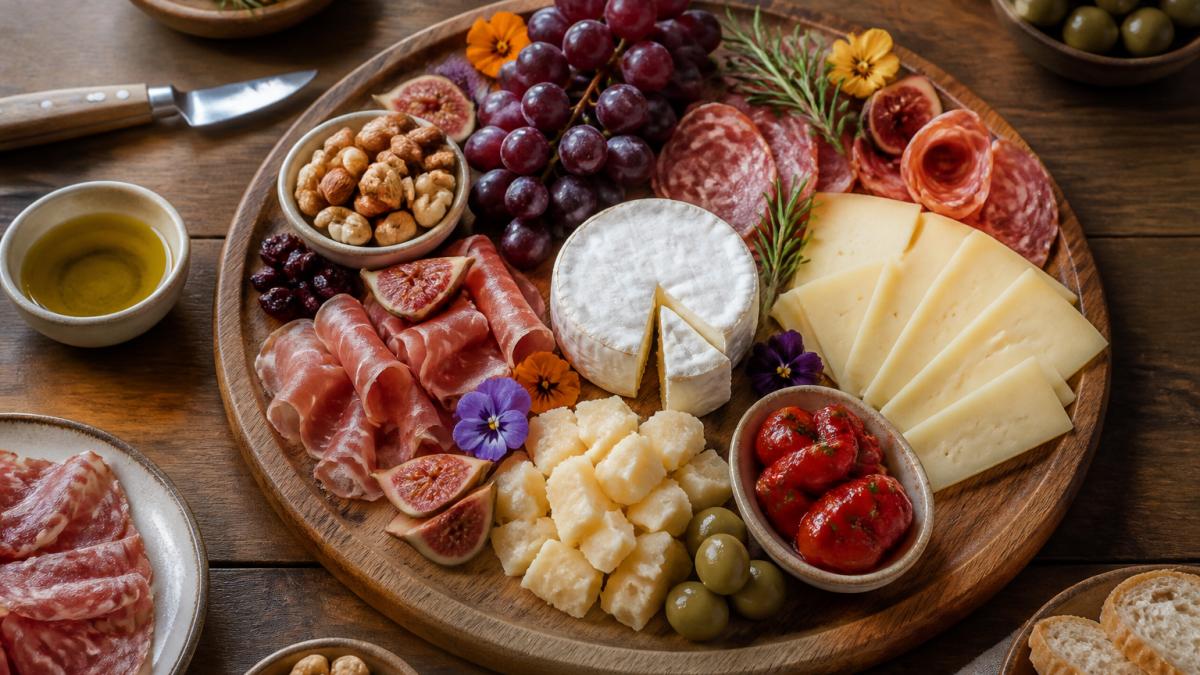
Step 2: Place the cheeses (3 minutes). Space the three cheeses apart so guests can reach each one without disturbing the others. Cut one slice from each wedge to signal that it is meant to be eaten, then leave the rest whole for guests to slice themselves. Put the hardest cheese nearest the center and the softest cheese toward the edge, where it is less likely to be knocked over.
Step 3: Add the cured meats (3 minutes). Fold or roll each slice loosely into quarters or thirds and group each meat type in its own cluster. Loose folds look more elegant than flat slices and make individual pieces easy to grab. Keep meat clusters next to a cheese they pair with rather than scattering them.
Step 4: Fill gaps with crackers and bread (2 minutes). Stand some crackers upright in clusters to add height, and lay others flat to fill empty spaces. A common pattern is to fan crackers around a cheese wedge so guests can take a cracker and a slice in one motion.
Step 5: Add olives, pickles, and peppers (2 minutes). Group similar items together in small clusters rather than scattering them randomly. This creates visual rhythm and makes the board easier to navigate. If a bowl already holds olives, do not duplicate them elsewhere.
Step 6: Place fresh fruit and nuts last (2 minutes). These fill remaining gaps and add color. Grapes create natural clusters. Nuts look best in small piles rather than spread thin.
Step 7: Finish with garnish (1 minute). Add rosemary sprigs, a light drizzle of honey, and a pinch of finishing salt. Garnish is the last layer because it sits on top of everything else.
The gap-filling rule. After the anchors are placed, look at the board from directly above. Any gap larger than a cracker is a spot for a small component.
Balance is key. If one side of the board looks heavier, move a cheese wedge or a bowl to the lighter side and re-check from above. Small adjustments at the end are normal and take less than a minute.
Charcuterie Board Ideas for Beginners
Different occasions call for different board styles. Here are three simple approaches that work well for beginners.
The Classic Board combines familiar flavors everyone enjoys. Use mild cheeses like Gouda and young Cheddar. Add prosciutto and mild salami. Include plenty of crackers, grapes, and almonds.
The Mediterranean Board leans into bold, tangy flavors. Finish with use rosemary olive oil for bread dipping and drizzling, a classic charcuterie board element.
The Sweet and Savory Board balances opposite tastes. Mix creamy brie with sharp Cheddar. Add prosciutto for salt. Include dried figs, fresh grapes, and candied nuts. Drizzle with honey.
The easiest approach for beginners is to start with one style, master it, then experiment. There's no pressure to be creative immediately. Solid fundamentals matter more than novelty.
Preparing and Serving Your Board
Timing is crucial. Assemble your board no more than 2 hours before serving. This prevents cheese from drying out and crackers from becoming stale.
Remove cheese from the refrigerator 30 minutes before serving. This allows flavors to develop fully. Cold cheese tastes muted.
Arrange everything on your platter just before guests arrive. This keeps everything fresh and looking its best.
Set out small plates, napkins, and spreaders. Guests appreciate having tools to work with. Spreaders make it easier to portion cheese without touching it directly.
Learn about flavored olive oils specifically for bread dipping, a key charcuterie board component to elevate your serving experience.
Keep your board in a cool area away from direct sunlight. Heat causes cheese to soften too quickly.
| Element | Timing | Best Practice |
|---|---|---|
| Remove cheese from fridge | 30 minutes before | Allows flavors to develop |
| Assemble board | 1-2 hours before | Prevents drying out |
| Set out spreaders | Upon arrival | Makes eating easier |
| Keep in cool area | Throughout service | Maintains cheese texture |
| Refresh fruit | Midway through | Prevents browning and wilting |
Frequently Asked Questions
What are the basic components of a charcuterie board for beginners?
A beginner charcuterie board needs three core elements: cheese (aim for one hard, one soft, and one blue variety), cured meats (prosciutto and salami work well), and crackers or bread. Add accompaniments like olives, pickles, fresh fruit, and nuts to round it out. These five categories create a balanced grazing board that offers variety in flavor and texture without overwhelming you with too many choices.
How much charcuterie per person should I plan for?
Plan for 2 to 3 ounces of cheese and 2 ounces of cured meats per person if the board is the main offering. If you're serving it as an appetizer alongside other food, reduce portions to 1 to 1.5 ounces of cheese and 1 ounce of meat per guest. Include 3 to 4 crackers per person, plus a small handful of accompaniments like olives, fruit, and nuts.
Can I prepare a charcuterie board ahead of time?
Yes, you can prep components the day before: slice cheeses and meats, arrange them in airtight containers, and store them separately in the refrigerator. Assemble the board itself 1 to 2 hours before guests arrive to keep ingredients fresh and prevent crackers from becoming soggy. Keep the board in a cool area, and cover it loosely with plastic wrap if you need to hold it longer than 2 hours.
What premium ingredients can elevate a beginner's charcuterie board?
High-quality aged balsamic vinegar and exceptional olive oils can elevate simple accompaniments into sophisticated offerings. Drizzle an aged balsamic reduction over soft cheeses, or pair premium olive oil with fresh bread for dipping. These artisanal additions can create memorable flavor moments without requiring complex preparation, and they're especially effective for enhancing guests' experience while keeping assembly straightforward.
Building how to build a charcuterie board for beginners doesn't require fancy training or expensive equipment. Start with quality ingredients from trusted sources like The Oil & Vinegar Bar, where our handcrafted olive oils and aged balsamic vinegars add depth to every element on your board. Follow these steps, trust your instincts, and you'll create a spread that impresses. Your guests will taste the care you put into selecting each ingredient and arranging them thoughtfully.
