

Extra Virgin Olive Oil for Frying: A 2026 How-To Guide
Table of Contents
- What You'll Need Before You Start Frying
- The Truth About the Smoke Point of Extra Virgin Olive Oil
- Health Benefits of Cooking with Olive Oil
- Best Olive Oil for Deep Frying and Pan Frying
- Step-by-Step: How to Fry with Extra Virgin Olive Oil
- Common Mistakes to Avoid When Frying with Extra Virgin Olive Oil
- Reusing, Storing, and Pairing Your Frying Oil
- Frequently Asked Questions
Last Updated: September 26, 2026
What You'll Need Before You Start Frying
Extra virgin olive oil for frying works beautifully when you set up right. This guide from The Oil & Vinegar Bar covers the right oil, gear, and temperature.
Here's your starting kit:
- A heavy-bottomed pot or deep skillet
- A kitchen thermometer that clips to the pot
- Fresh extra virgin olive oil
- A slotted spoon or spider strainer
- Paper towels or a wire rack
- Your food, patted dry
That's it. No special fryer required.
The Truth About the Smoke Point of Extra Virgin Olive Oil
The smoke point of extra virgin olive oil is higher than most people think. Fresh, high-quality extra virgin oil typically smokes between 375°F and 410°F, which covers most frying jobs.
So why does everyone say otherwise?
Why the Smoke Point Myth Persists
The myth survives because people confuse refined and unrefined oils. Refined olive oil has a higher smoke point because processing strips out compounds; extra virgin keeps them, so older guides assumed it was fragile.
Health Benefits of Cooking with Olive Oil
Cooking with extra virgin olive oil brings real advantages over other frying fats, thanks to its natural compounds, not additives.
Here's what you get:
- Monounsaturated fats that hold up well under heat
- Polyphenols and antioxidants that support heart health
- No trans fats, unlike partially hydrogenated oils
- Vitamin E and other nutrients that survive moderate frying
Best Olive Oil for Deep Frying and Pan Frying
The best olive oil for deep frying is a fresh extra virgin with a clean, peppery finish. High polyphenols and low acidity signal an oil that resists thermal degradation.
What to look for:
- Dark glass bottles that protect against light
Step-by-Step: How to Fry with Extra Virgin Olive Oil
Frying with extra virgin olive oil comes down to three things: the right oil, the right temperature, and steady monitoring. Follow these steps for crisp results without the guesswork.
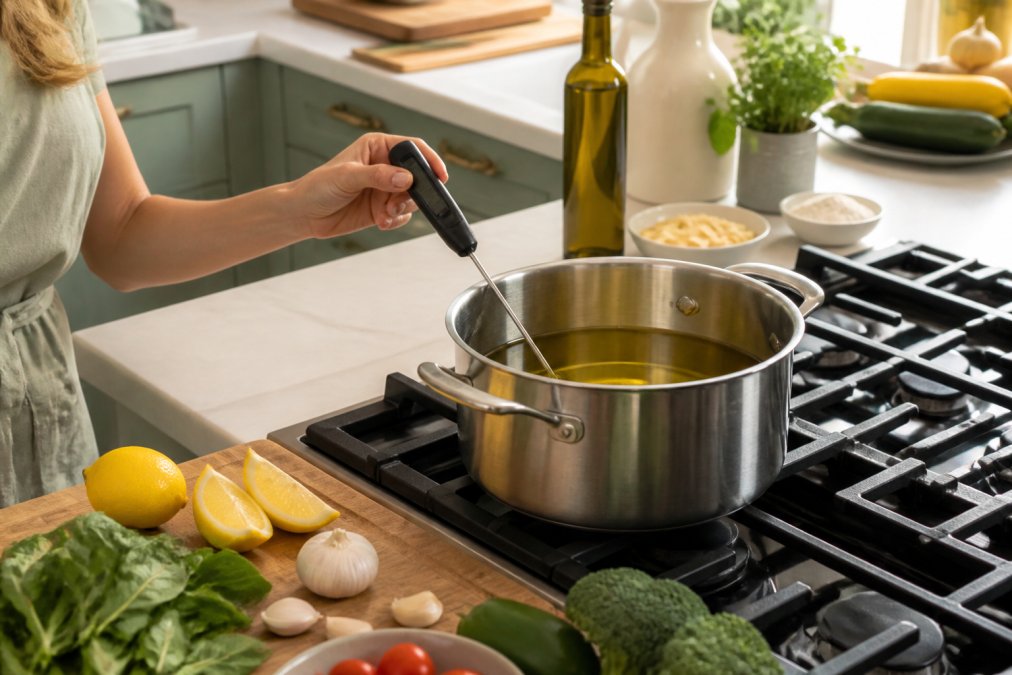
Step 1: Choose the Right Oil and Equipment
Pick a fresh extra virgin olive oil and a heavy-bottomed pot. The thick base holds heat steady, so the temperature doesn't swing when food goes in.
Cookware material matters more than most guides admit.
- Cast iron holds heat exceptionally well and recovers quickly when cold food hits the oil. The trade-off: it takes longer to heat and can run hot if you don't watch the thermometer. Best for deep frying and multiple batches.
- Stainless steel with a thick aluminum or copper core is the most responsive option, heating evenly and adjusting quickly when you turn the burner down. Good for pan and shallow frying.
- Enameled cast iron behaves like cast iron but is easier to clean. Avoid metal utensils that can chip the enamel.
- Nonstick is a poor choice for frying. Most nonstick coatings are not rated for sustained temperatures above 400°F, and the coating can degrade. Save it for eggs.
- Carbon steel is a lighter alternative to cast iron with similar heat retention. It seasons like cast iron and works well for shallow frying.
Step 2: Heat to the Correct Temperature
Pour in enough oil to submerge your food, then heat to 350°F to 365°F. Clip your thermometer to the pot and watch it, oil heats unevenly at first.
Why 350°F-365°F is the sweet spot:
- Below 325°F, food absorbs oil instead of sealing, and you get greasy results.
- Above 375°F, the exterior browns before the interior cooks through, and you edge toward the oil's smoke point.
- Between 350°F and 365°F, the surface dehydrates fast enough to form a crisp crust while heat conducts inward at a rate that cooks the center.
Step 3: Fry, Monitor, and Adjust
Add food in small batches. Too much at once drops the temperature fast.
Signs the oil is telling you something:
- Vigorous bubbling around the food, normal. That is moisture escaping.
- Bubbling slows to a trickle, the food is nearly done; moisture is mostly gone.
- Oil foams up the sides of the pot, too much food, or the oil is breaking down. Stop and reassess.
- Faint blue smoke, you are at or near the smoke point. Turn the heat down immediately.
- Dark, acrid smoke, the oil is degraded. Let it cool, discard it, and start fresh.
Here's a quick reference for common foods:
| Food | Oil Temperature | Fry Time |
|---|---|---|
| Chicken cutlets | 350°F | 4-5 min per side |
| Potato wedges | 360°F | 5-7 min |
| Doughnuts | 365°F | 2-3 min per side |
| Vegetables | 350°F | 2-4 min |
| Fish fillets | 350°F | 3-4 min per side |
| Falafel | 350°F | 3-4 min |
The equipment you choose and the way you manage temperature swings matter more than the brand on the bottle. A heavy pot, a calibrated thermometer, and small batches will outperform expensive oil in a thin pan every time.
Common Mistakes to Avoid When Frying with Extra Virgin Olive Oil
Most frying failures trace back to a few repeat offenders:
- Wet food. Pat everything dry. Water makes oil spatter and steam instead of crisp.
- Crowding the pot. Cook in batches, even if it takes longer.
- Skipping the thermometer. Guessing leads to greasy or burnt results.
- Reusing oil too long. More on that below.
- Storing oil near the stove. Heat and light speed up breakdown.
Never let oil smoke heavily and keep frying. Once it hits the smoke point threshold, it's breaking down. That means off flavors and more free radicals. Let it cool, strain it, and start fresh if the oil looks dark.
Reusing, Storing, and Pairing Your Frying Oil
Most guides stop at the first fry. This section covers what happens after: how many times you can safely reuse extra virgin olive oil, how to filter and store it, and how to match its flavor to specific foods.
How Many Times Can You Reuse Extra Virgin Olive Oil?
A consistent pattern across culinary and food-science sources is:
- 3-4 uses for clean frying, vegetables, potatoes, doughnuts, and other low-protein, low-batter foods
- 2-3 uses for breaded or battered foods, which shed more particles into the oil
- 1-2 uses for strongly flavored or heavily seasoned foods like fish or marinated chicken
These are starting points, not guarantees. The oil tells you when it is done. Retire it when any of these appear:
- It darkens noticeably or turns cloudy at room temperature
- It smells rancid, crayon-like, or sharply acrid rather than faintly olive-y
- It foams aggressively when reheated
- It smokes at a lower temperature than it did on the first fry
- It leaves a sticky film on the pot or utensils
How to Filter and Store Used Oil
Filtering makes reuse safe and keeps flavor from carrying over.
- Cool completely. Never strain hot oil. Wait at least two hours, or until the container is comfortable to touch.
- Remove large debris first. Use a slotted spoon or spider strainer to lift out big pieces.
- Strain through a fine mesh strainer lined with a paper coffee filter or a layer of cheesecloth. For very fine particles, strain twice.
- Funnel into a clean, dry glass jar with a tight-fitting lid. Dark glass is ideal; if you only have clear glass, store it in a cabinet.
- Label it with the date of first use and the number of fries.
Storage rules that matter:
- Keep it away from light and heat, not next to the stove or on a sunny windowsill.
- A cool, dark cabinet is fine for a few weeks. For longer storage, refrigerate; the oil will solidify, so let it come to room temperature before measuring.
- Use within 4-6 weeks of the first fry. Flavor and stability decline after that.
- Never top off used oil with fresh oil, you lose track of the oldest oil's age.
Do not pour used frying oil down the sink. It solidifies in pipes and causes clogs. Let it cool, seal it in a disposable container, and check with your local municipality about household hazardous waste or grease recycling drop-off.
Matching the Oil's Flavor to the Food
Extra virgin olive oil is not neutral, and that is the point. Flavor transfer runs both ways: the oil flavors the food, and the food flavors the oil.
- Peppery, robust oils (common in Tuscan and Greek bottlings) stand up to fried chicken, potatoes, and root vegetables. The bitterness cuts through richness.
- Smooth, buttery oils (common in some Spanish and Tunisian bottlings) suit delicate foods, fried fish, zucchini blossoms, light fritters, where a strong peppery note would dominate.
- Grassy, herbal oils pair well with vegetables, falafel, and anything with lemon or herbs in the coating.
- Avoid strongly flavored oils for desserts. Doughnuts, churros, and fried fruit are better with a mild, clean oil so the sugar and spice lead.
A Simple Reuse Workflow
- Fry the mildest food first.
- Cool, strain, and label the oil.
- Reuse for a similar or stronger-flavored food within the next few weeks.
- Retire the oil when it darkens, foams, or smells off.
That workflow alone saves most home cooks money and produces better-tasting food than buying fresh oil for every batch.
Frequently Asked Questions
Is it safe to fry food in extra virgin olive oil?
Yes, extra virgin olive oil is safe for frying. Its high monounsaturated fat content and natural antioxidants make it resistant to breakdown at typical frying temperatures (350-375°F). Studies show it produces fewer harmful compounds than many refined oils. Just keep the oil below its smoke point and avoid overheating.
What is the smoke point of extra virgin olive oil?
The smoke point of extra virgin olive oil typically ranges from 350°F to 410°F, depending on quality and processing. This is well above the ideal deep-frying temperature of 350-375°F. For pan frying and sautéing, you rarely exceed 300°F, so extra virgin olive oil is perfectly safe for these methods.
Does extra virgin olive oil lose its health benefits when heated?
Some antioxidants degrade with heat, but extra virgin olive oil retains a significant portion of its polyphenols and monounsaturated fats even after frying. So you still get health benefits, though raw use preserves the most antioxidants.
How do I prevent extra virgin olive oil from smoking while frying?
Use a thermometer to keep the oil between 350-375°F. Choose a heavy-bottomed pot to maintain steady heat. Don't overcrowd the pan, as adding cold food drops the temperature and can cause smoking. Also, strain and store oil properly between uses to remove food particles that lower the smoke point.