

How to Pair Olive Oil with Food for Better Flavor
Last Updated: November 7, 2026
Quick Summary
To learn how to pair olive oil with food, match the oil's intensity to the dish: mild oils suit delicate foods like white fish and eggs, while strong peppery oils stand up to steak, lamb, and bitter greens. Taste the oil first, then use strong oils as finishers and milder oils for cooking.
- Pour about a tablespoon into a cup, warm it in your hands, sip, and note where the peppery tingle lands.
- A long, strong tingle means a strong oil; a faint warmth means mild.
- Dress vegetables twice: a medium oil for cooking, a flavorful finishing oil at the table.
- Drizzling very strong oil over delicate white fish is the most common home-kitchen mismatch.
- Keep at least two intensities on hand and store bottles in a cool, dark cabinet.
Table of Contents
- Start with Intensity: The Core of Olive Oil Pairing
- How to Taste Olive Oil and Identify Its Intensity
- What Foods Pair Well with Olive Oil: A Practical Guide
- Your Olive Oil Food Pairing Chart at a Glance
- How to Pair Flavored Olive Oils with Meals
- How to Use Olive Oil as a Finishing Oil
- Common Pairing Mistakes, Storage, and Serving Temperature
- Build Your Own Pairing Flight at The Oil & Vinegar Bar
- Frequently Asked Questions
Start with Intensity: The Core of Olive Oil Pairing
Learning how to pair olive oil with food starts with one rule: match the oil's intensity to the dish.
The oils we carry come from Spain, Tunisia, Greece, and Italy, and one of the biggest differences between them is intensity. A peppery oil will flatten a mild white fish.
Think of intensity as a dial with three settings:
- Mild: buttery, soft, low bitterness
- Medium: balanced, fruity, a gentle peppery finish
- Strong: grassy, bitter, leaves a strong peppery tingle
If you want to browse by strength, you can shop the full olive oil range and pick a bottle at each level.
How to Taste Olive Oil and Identify Its Intensity
To taste olive oil, pour a small amount into a cup, warm it in your hands, sip it, and note where the peppery tingle lands in your throat. A strong cough or burn at the back of the throat signals a strong oil.
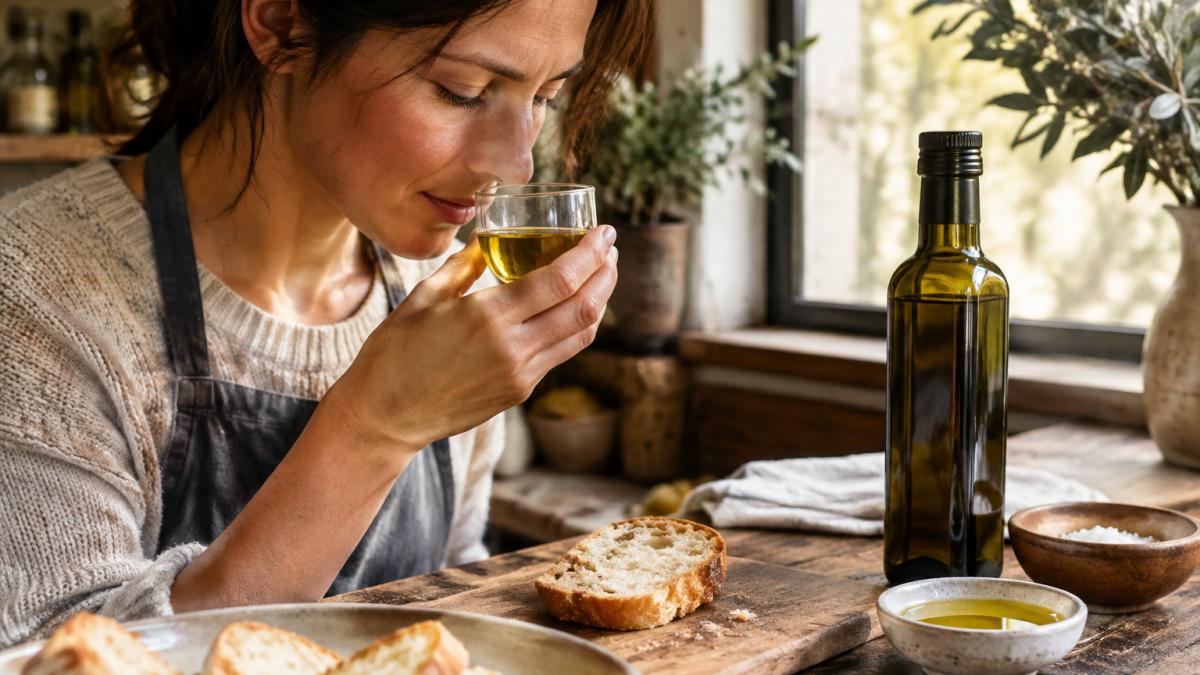
Here is a simple tasting method we walk customers through:
- Pour about a tablespoon into a small cup.
- Cup it in your hands to warm it slightly.
- Smell it first. Fresh grass? Artichoke? Citrus?
- Take a small sip and pull air across your tongue.
- Swallow and count how long the peppery feeling lasts.
Long, strong tingle means strong. A faint warmth means mild. The UC Davis Olive Center tasting guide explains the same sensory test used by professional tasters.
What Foods Pair Well with Olive Oil: A Practical Guide
Most foods pair well with olive oil when the oil's intensity matches the dish's weight and flavor, but intensity alone is only half the decision. The other half is flavor direction: does the oil's own character complement the food, or contrast with it on purpose? A grassy, artichoke-toned oil complements green vegetables and contrasts nicely with sweet roasted squash. A buttery, low-bitterness oil complements eggs and mild fish but disappears under charred meat.
Bread, Dipping, and Charcuterie
Bread dipping works best with a medium or strong oil that clings to the crust. Pour a pool on a plate, add a pinch of sea salt, and dip. For cured meats and carpaccio, use a peppery oil to cut through the richness. A medium, fruity oil with a soft peppery finish is the safest all-purpose choice for a board that mixes bread, cheese, and cured meat, because it will not overpower fresh mozzarella or mild prosciutto but still registers against salami.
For flavored options built for boards, see our picks for flavored olive oil for bread dipping.
Vegetables, Greens, and Salads
Roasted and grilled vegetables take a medium oil well. Bitter greens like arugula and radicchio need a strong, grassy oil to balance their edge. For salad dressing, whisk a mild oil with vinegar so the greens stay fresh.
- Roasted root vegetables: medium oil; the caramelized edges need a fruity oil with enough bitterness to keep the sweetness in check
- Grilled zucchini and eggplant: mild or lemon oil; both vegetables are water-heavy and absorb flavor readily, so a delicate oil reads clearly
- Arugula and radicchio: strong oil; the oil's bitterness meets the greens' bitterness instead of fighting it
- Delicate lettuce: mild oil only; a robust oil turns butter lettuce slick and bitter
- Tomatoes: medium to strong, ideally a grassy oil; the acidity of the tomato needs fruitiness and a peppery finish to balance it
- Steamed green beans or broccoli: medium oil drizzled after cooking, not before, so the aroma survives
A common pattern is to dress vegetables twice: a neutral or medium oil for the cooking surface, then a more flavorful finishing oil at the table.
Fish, Seafood, Meat, and Poultry
White fish and seafood call for a mild or lemon oil. Salmon and grilled shrimp handle a medium oil.
The rule is simple: the lighter the protein, the gentler the oil. But the mechanism matters.
For meat, the deciding factor is surface char and fat content. These pairings reflect how authentic Mediterranean cuisine lets the character of the meat guide the choice of oil, from a gentle herbal note to a bold, grassy finish.
Watch out: drizzling a very strong oil over a delicate white fish is the single most common mismatch in home kitchens, and it makes the fish taste muddy rather than the oil taste bold.
Pasta, Eggs, Soups, and Popcorn
Pasta and pesto love a fruity medium oil. Eggs, whether scrambled or fried, taste better with a mild, buttery oil. Finish soups with a drizzle just before serving. Popcorn takes a strong oil that holds its flavor against salt.
A few specifics make these pairings more reliable:
- Pasta with tomato sauce: medium to strong, fruity oil; the fruitiness echoes the tomato and the peppery finish keeps the sauce from tasting flat
- Pasta with garlic and oil: medium oil; a very strong oil plus raw garlic becomes aggressively bitter
- Pesto: medium, fruity oil; a strongly bitter oil overwhelms the basil
- Scrambled eggs: mild, buttery oil; a robust oil makes eggs taste metallic
- Fried eggs: medium oil with a soft peppery finish; the browned edges can carry more flavor than scrambled curds
- Clear broths and vegetable soups: medium oil drizzled at the table; the oil floats and releases aroma with each spoonful
- Creamy soups: mild to medium oil; a strong oil clashes with dairy
- Popcorn: strong, peppery oil; the salt and crunch mute delicate flavors, so the oil needs to be assertive to register
A useful habit is to taste the oil on its own before you commit it to a dish. If the peppery tingle lingers for several seconds, treat it as a strong oil and use it as a finisher rather than a cooking medium.
Your Olive Oil Food Pairing Chart at a Glance
Use this olive oil food pairing chart as a quick reference. Find your food, then pick the oil intensity that matches it.
| Food | Oil Intensity | Why It Works |
|---|---|---|
| Bread and bruschetta | Medium or strong | Clings well, adds punch |
| Charcuterie and carpaccio | Strong | Cuts through richness |
| Roasted vegetables | Medium | Balances caramelized edges |
| Bitter greens | Strong | Matches the bite |
| White fish | Mild or lemon | Stays delicate |
| Steak and lamb | Strong | Stands up to char |
| Pasta and pesto | Medium | Fruity, blends well |
| Eggs | Mild | Buttery, not overpowering |
| Popcorn | Strong | Holds flavor against salt |
How to Pair Flavored Olive Oils with Meals
To pair flavored olive oil with meals, treat the flavor as an ingredient, not a garnish.
Here is how to pair flavored olive oils with meals:
- Lemon oil: seafood, grilled chicken, salads, and steamed vegetables. The acidity of the lemon echoes the brightness of the dish; use it where you would otherwise squeeze a lemon.
- Basil oil: caprese, pasta, roasted vegetables, and tomato soup. Basil is a sweet herb, so it complements rather than contrasts; avoid pairing it with strongly bitter greens, where the two herbaceous notes compete.
- Blood orange oil: duck, desserts, green salads, and dark chocolate. The fruit's sweetness and slight bitterness bridge savory and sweet dishes; it is one of the few flavored oils that works on both sides of the meal.
- Garlic oil: pizza, bread, roasted meats, and sautéed greens. Garlic is assertive, so use it where garlic would go anyway; it will overwhelm delicate fish and eggs.
- Rosemary or herb oils: roasted potatoes, lamb, white beans, and focaccia. Resinous herbs stand up to starchy, earthy foods that would mute a delicate flavor.
- Chili oil: eggs, pizza, pasta, and grilled vegetables. Heat compounds with the oil's own peppery finish, so a chili oil on a robust base can become very aggressive; use it as a finisher, not a cooking oil.
- Truffle oil: pasta, risotto, mushrooms, and popcorn. Truffle aroma is volatile and intense; a few drops at the table are enough, and heat destroys the aroma, so never cook with it.
A common pattern is to use flavored oils as finishing oils rather than cooking oils.
Watch out: flavored oils can clash when a dish already contains the same flavor in a different form.
Our savory blends are built for exactly this kind of meal pairing.
How to Use Olive Oil as a Finishing Oil
A finishing oil is olive oil added at the end of cooking, not during it. You drizzle it over a finished dish to add fresh flavor and aroma that heat would otherwise destroy.
A finishing oil can be used this way:
- Drizzle over pasta right before serving
- Spoon over soup at the table
- Finish grilled fish or chicken off the heat
- Add a thread to hummus or mashed potatoes
If you want to understand how olive oil behaves when heated rather than drizzled, our guide on extra virgin olive oil for frying covers the cooking side.
Common Pairing Mistakes, Storage, and Serving Temperature
The most common pairing mistake is using one oil for everything. A strong oil on a delicate dish overwhelms it. A mild oil on a bold dish vanishes.
Watch out: storing oil in direct sunlight or near the stove speeds up staleness and ruins the flavor you paid for.
Other mistakes to avoid:
- Skipping the taste test before pairing
- Using old oil past its freshness window
- Serving oil ice-cold, which mutes flavor
Store your bottles in a cool, dark cabinet. Serve oil at room temperature so the aromas open up. For fuller guidance, see our storage and serving tips.
Build Your Own Pairing Flight at The Oil & Vinegar Bar
The fastest way to learn how to pair olive oil with food is to taste several side by side.
Our Sevillano Extra Virgin Olive Oil ($26.00) is smooth and full-flavored, with hints of artichokes and fresh herbs, and works well for bread dipping and salads.
Get started with The Oil & Vinegar Bar and build a pairing flight that teaches your palate in one afternoon.
Frequently Asked Questions
What foods pair well with robust extra virgin olive oil?
Robust oils with bitter, peppery notes stand up to bold food. Use them on grilled steak, roasted lamb, hearty tomato sauces, bitter greens like radicchio and broccoli rabe, bean soups, and paella. They also work in pesto and drizzled over aged cheese. A robust oil will overwhelm delicate fish or fresh salad greens, so save it for dishes with char, garlic, and deep flavor. Try a peppery Greek-style oil on grilled vegetables straight off the heat.
Can you put olive oil directly on food?
Yes, and for finishing it is often the best way to use it. A raw drizzle over pasta, soup, grilled fish, or bread preserves the oil's fruity aroma and peppery kick, which heat can dull. Add it after cooking, not during, when you want the flavor to lead. Use about a teaspoon to a tablespoon per serving. This is exactly how a finishing oil is meant to be used, and it is the fastest way to taste the difference between a mild oil and a robust one.
How do you choose an olive oil to pair with a dish?
Match the oil's intensity to the food's intensity. Mild, buttery oils suit delicate dishes like white fish, eggs, mayonnaise, and fresh salads. Medium oils with balanced fruit and pepper fit pasta, roasted vegetables, chicken, and bruschetta. Robust, peppery oils belong with red meat, bitter greens, garlic-heavy sauces, and charred food. When in doubt, taste the oil on plain bread first, then taste it with the dish. The pairing that does not bury either flavor is the right one.
Do you refrigerate olive oil after opening?
No. Refrigeration can cause olive oil to solidify and can introduce condensation, which speeds up spoilage. Store it in a cool, dark cupboard away from the stove and keep the cap tight. Heat, light, and air are the real enemies, so a dark glass bottle in a closed cabinet does more for freshness than the fridge ever will.
